



Anti-tanking proposals spark heated debate! Prominent journalist criticizes them as garbage: playoff teams shouldn't get lottery picks



On March 27 Beijing time, according to prominent reporter Shams, ESPN sources revealed that the NBA submitted three comprehensive anti-tanking reform proposals to the league's board of governors yesterday. Each proposal is expected to be adjusted before the official vote in May. After the three proposals were exposed, they quickly sparked heated discussion,journalist Siegel criticized these proposals as garbage.
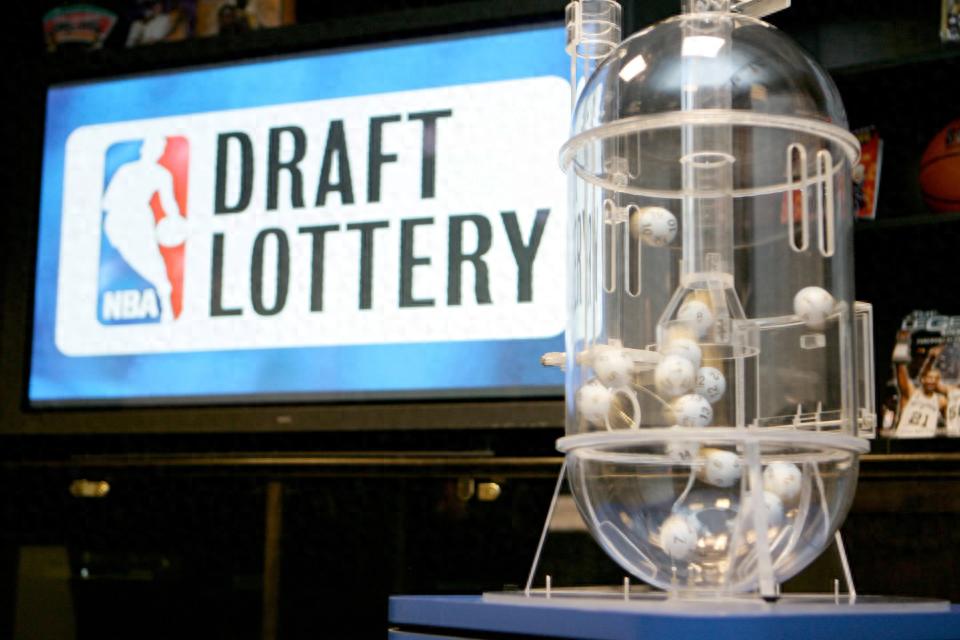
First, let's look at the specific three proposals—
Proposal One
Expand lottery teams from 14 to 18, adding the No.7 and No.8 seeds from each conference.
Equalize the odds for the 10 teams with the worst records, each receiving an 8% chance for the No.1 pick.
The remaining 20% probability for the No.1 pick is distributed among the other 8 teams based on descending order of record; the team with the worst record within this group (i.e., the 11th worst in the league) gets the highest probability.
All 18 draft positions are determined through the lottery draw.
Proposal Two
Expand lottery teams from 14 to 22, including all non-playoff teams and teams eliminated in the first round of the playoffs.
Team lottery probabilities will be calculated based on combined records from the past two seasons. For example: a team with 45 wins one year and 25 wins another year will be calculated as 35 wins in the lottery.
Set a minimum win floor. For example, with a floor of 20 wins, a team with 15 wins and 67 losses will be calculated as 20 wins and 62 losses in the lottery.
Consistent with the current rules, only the top 4 picks are determined by lottery draw.
Proposal Three
Expand lottery teams from 14 to 18, adding the No.7 and No.8 seeds from each conference.
The five teams with the worst records have equal probability for the No.1 pick, with probabilities decreasing thereafter (starting from the 6th worst team).
The top 5 picks are determined through the lottery draw.
After the top 5 picks are determined, a separate lottery draw is held for the remaining 13 teams.
Teams among the bottom 5 in record cannot end up with a pick lower than No.10.
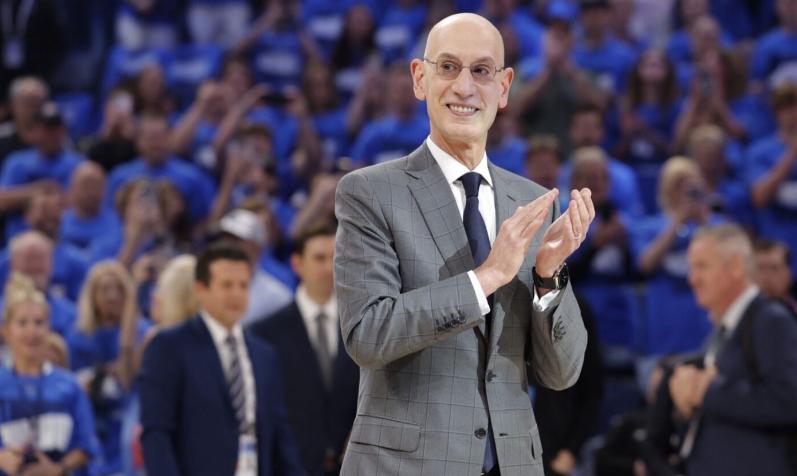
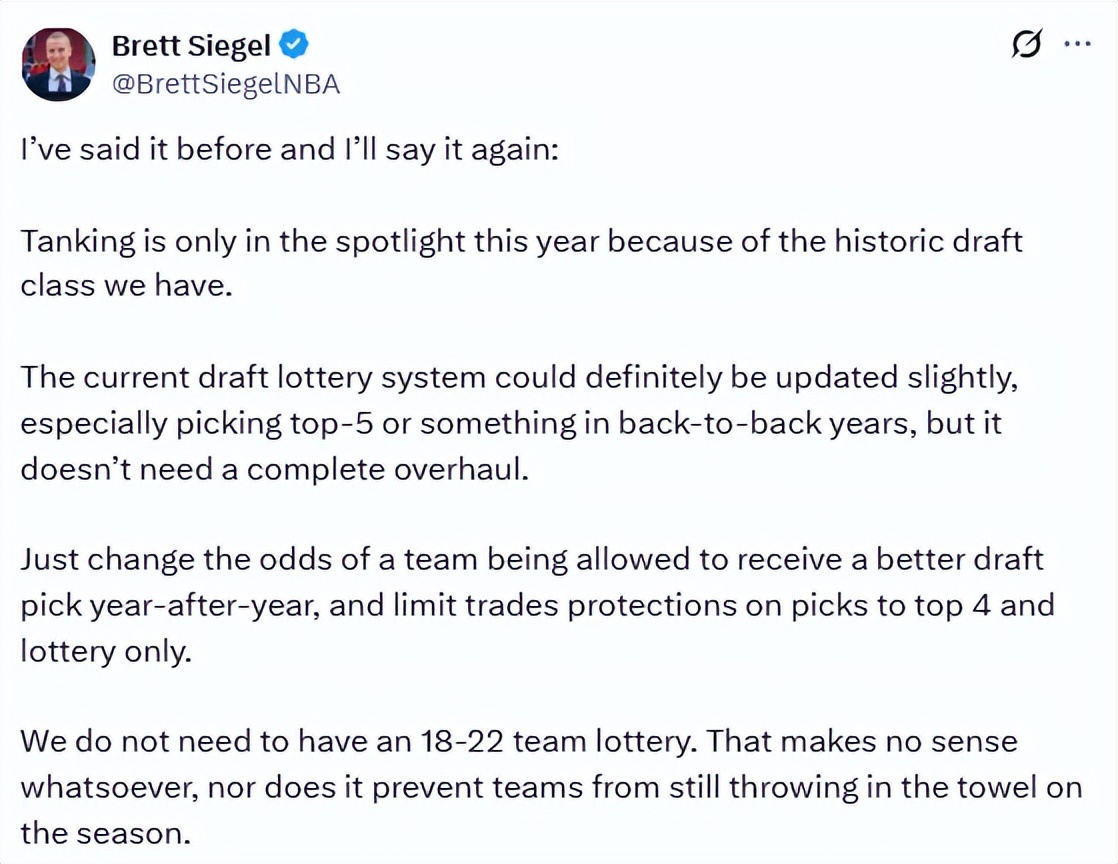
After journalist Siegel criticized these proposals as garbage, he provided the following interpretation—
Teams that make the playoffs should have absolutely no chance of getting a lottery pick. This is not the right way to address the problems of the current system. Such changes would only make it harder for teams that genuinely lack talent and cannot win games to improve, ultimately trapping them forever in the cycle of being bad teams.
I've said it before, and I'll say it again: tanking has received so much attention this year entirely because this draft class is considered historically talented.
The current lottery system could indeed be slightly optimized, such as limiting teams from getting top-five picks consecutively for two years, but there's no need for a complete overhaul. Just tweak the rules to limit the probability of teams getting better picks year after year, and tighten the protection clauses in draft pick trades, allowing only top-four protection and lottery protection.
We absolutely don't need to involve 18 to 22 teams in the lottery together. This is completely unreasonable and still wouldn't stop teams from tanking and abandoning seasons.
Salary cap expert Marks also noted: The consequences of lottery reform could significantly impact teams that owe future first-round picks or pick swap rights. Starting from 2027, over the next 7 years, 21 teams will owe at least one first-round pick or one pick swap right.


Wonderfulshortvideo
i know, they’re mine. thank you


This energy >>>>>
Listen as the crowd roars at the sight of Tatum’s first run out this season! 🤩
23 + 77 = 💯
LUKE KENNARD FROM DEEP. GOODNIGHT.
Watch as SGA drills the game-winning three 🙂↕️
Tatum gets the putback ➡️ three as his first and second buckets back since returning 🔥 🔥 🔥
 Links
Links
 Contact
Address:UNIT 1804 SOUTH BANK TOWER, 55 UPPER GROUND,LONDON ENGLAND SE1 9E
Number:+85259695367
E-mali:[email protected]
 App
App


