



Malaysia Struggles to Break the Jinx Against Vietnam's National Team



With the penalized naturalized players absent, Malaysia faces Vietnam's national team again in a condition of instability in both lineup and spirit. Facing Vietnam's stable and deep squad, coach Peter Cklamovski is hard-pressed to produce an upset at Thiên Trường.
The sanctions issued by FIFA and AFC regarding illegal naturalized players delivered a major shock to Malaysian football.
Not only losing key personnel, the team also suffered a severe blow to its confidence and stability, elements that have been fragile for many years.

Coach Peter Cklamovski recently expressed deep disappointment after receiving the verdict of a forfeited loss to Vietnam's national team. Photo: MNT
Under the tenure ofCoach Peter Cklamovski, Malaysia had hoped to make a breakthrough through its naturalization policy.
However, when the crucial "advantage" of superior foreign players was stripped away, Malaysia was forced to revert to relying on domestic players and the "legitimate" but less outstanding naturalized group.
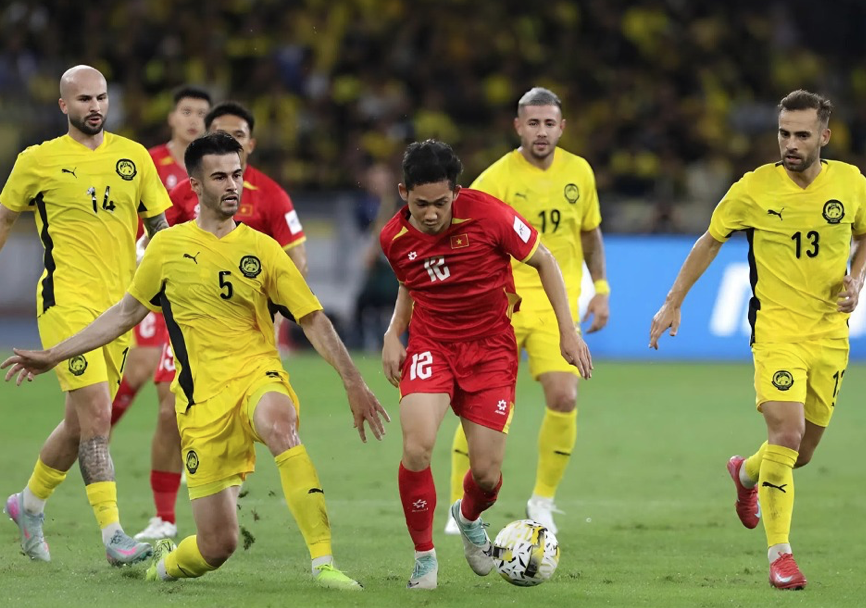
With a significantly weaker squad compared to the first leg, Malaysia is rated lower than Vietnam's national team for the return match. Photo: MNT
Ironically, that is precisely the group of players who have repeatedly lost to Vietnam's national team over the past decade. The history of encounters serves as clear evidence.
For over 10 years, Malaysia has almost never beaten Vietnam in official competitions. The consecutive defeats have created a psychological "jinx," turning each encounter into an invisible pressure. Now, with an even weaker squad, breaking that jinx seems more distant.
Not only weaker in personnel, Malaysia also faces mental issues. The forfeited loss and eliminated chances significantly impact their motivation. In such circumstances, the visiting team might opt for a respectable performance rather than going all out.
When morale is affected, maintaining focus and determination throughout the 90 minutes is not easy.
Conversely, Vietnam's national team is in a more stable state. Under coach Kim Sang Sik's guidance, the team not only maintains good form but also possesses a balanced squad. The emergence of new talents like Hoàng Hên makes the attack more diverse and unpredictable.
Without the support of high-quality naturalized players, the visiting team's defensive organization is questionable. Against a flexible Vietnam with multiple attacking options, holding firm is already a challenge, let alone creating a surprise.
The home ground factor is also a significant advantage for the host. Thiên Trường Stadium has long been considered a "cauldron," where crowd pressure can intimidate any opponent. In a context of wavering morale, Malaysia finds it even harder to maintain composure in such an environment.
Malaysialost the "lever" from the illegal naturalized players, forced to return to its inherent capabilities, which have never been sufficient to overcome Vietnam's national team over a long period.
Therefore, the match on March 31 carries more significance than a regular encounter. For Malaysia, it is a match for honor. But for Vietnam's national team, it is an opportunity to affirm stability and extend the positive streak.
For Malaysia at this moment, the story at Thiên Trường will likely just be a continuation of a familiar history.


Wonderfulshortvideo
Kvaratskhelia and Ronaldo 🫶


🇪🇸 Spain 🆚 Argentina 🇦🇷
Arsenal goal today arsenal 2-1 chelsea arteta interview arteta press conference
When Diogo Costa saved EVERY penalty he faced in the shoot-out 🤯🤯🤯
The movement is electric ⚡️
Mbappe injury mbappe surgery real madrid 0-1 getafe mbappe return date mbappe edit
ronaldo almeria ronaldo buying new club ronaldo owner ronaldo manchester united owner
 Links
Links
 Contact
Address:UNIT 1804 SOUTH BANK TOWER, 55 UPPER GROUND,LONDON ENGLAND SE1 9E
Number:+85259695367
E-mali:[email protected]
 App
App


