



Iga Swiatek splits with coach Wim Fissette: An inevitable decision after emerging "cracks"


Iga Swiatek's official parting with coach Wim Fissette after 18 months of collaboration signals that the Polish tennis player is entering a pivotal stage in her career. She faces a choice between persisting with the process of restructuring her playing style or seeking a new direction to salvage the stability that is gradually fracturing.
This decision comes amid Swiatek's fluctuating form since early 2026, culminating in a shocking loss to Magda Linette in the second round of the Miami Open, which ended her streak of 73 consecutive wins in opening matches.
The 18-month journey: Success intertwined with doubt
When Swiatek began working with Fissette in October 2024, it was seen as a strategic move to reinvent herself after a period of dominance that was gradually being decoded by opponents. Fissette is no stranger, having coached multiple Grand Slam champions like Kim Clijsters, Angelique Kerber, and Naomi Osaka. During their partnership, Swiatek still achieved significant accomplishments, notably the Wimbledon title, her career's biggest dream. Additionally, championships at the Cincinnati Open and Korea Open showed that the project to change her playing style was not entirely a failure.
However, the issue lies in this: That success did not come with stability. Instead of maintaining peak performance as she did under her previous coach, Swiatek began to suffer puzzling losses. The common thread in these defeats was the image of a player "stuck" between two styles, wanting to control points with solidity while also trying to overpower opponents with strength.
This is precisely the consequence of the tactical transition. Previously, Swiatek was famous for her relentless attacking style, but as opponents gradually adapted, she had to diversify. Fissette helped her return to a more flexible counter-punching style, which once allowed her to dominate the WTA in her early period.
But as with any major change, this process was not smooth. Under pressure, old habits resurfaced. In the Roland Garros 2025 semifinal, she lost to Aryna Sabalenka after failing to maintain stability in the deciding set, a clear demonstration of the "halfway" nature of her competitive identity.
The serve problem and psychological pressure
One of the key factors leading to the split was that Swiatek's core weaknesses were not thoroughly improved, particularly her serve. Compared to top rivals, Swiatek's serve has never been a truly formidable weapon. During her earlier successful period, this limitation was masked by her overpowering ability from the baseline. But as she shifted to a more controlling style, that weakness became more apparent than ever.
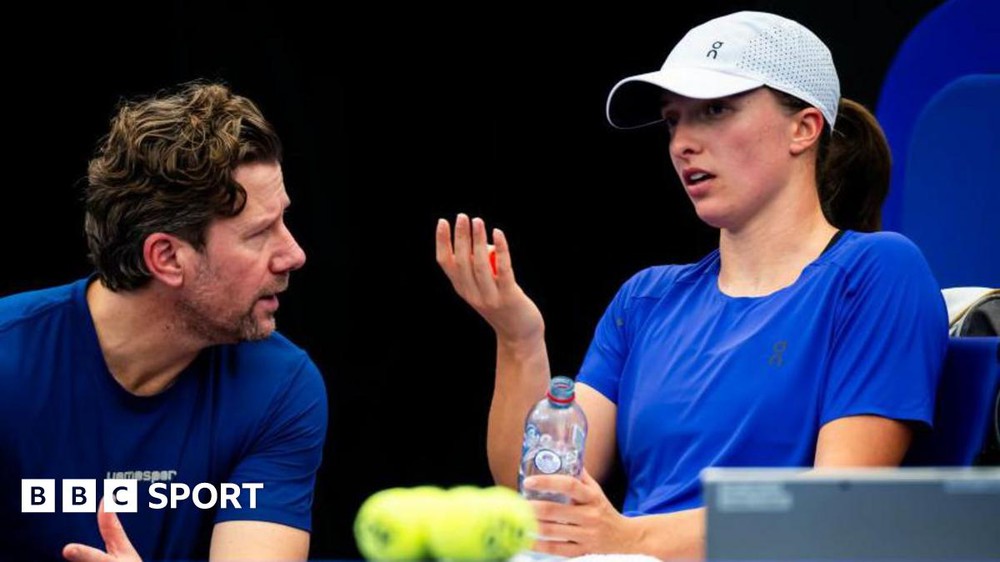
Iga Swiatek has parted with coach Wim Fissette after 18 months together
Not earning many points from her serve forced Swiatek into more extended rallies. This led to two consequences: Pressure piled onto her baseline shots and forced her to be more risky in return situations. The result was an increase in unforced errors, leading to instability throughout matches. Compared to Carlos Alcaraz, who significantly improved his serve to relieve pressure in tough moments, it's evident Swiatek still lacks a similar "release valve." This is seen as the biggest challenge her next coach must solve.
Psychological factors also played a crucial role. In many recent matches, Swiatek frequently displayed frustration with her team, including long-time psychologist Daria Abramowicz. These reactions indicated that the internal support team no longer maintained absolute consensus as before. That tension partly reflects the pressure Swiatek faces: losing the world No. 1 ranking, the prior suspension related to the banned substance TMZ, and the expectation to maintain a top position. When things no longer run smoothly, changing the coach becomes a understandable choice.
The upcoming turning point: Risk or opportunity for rebirth?
Parting with Fissette at this moment can be viewed in two ways. On one hand, it's a risky decision, because Swiatek's project to overhaul her playing style is still unfinished. Achievements like the Wimbledon title show she was on the right track, though not yet perfected. On the other hand, it could also be a necessary step to avoid falling into a prolonged "halfway" state, where she is no longer the dominant version of before, yet not sufficiently stable with the new style.
In her parting message, Swiatek admitted feelings of "disappointment, bitterness, but also many lessons learned." This shows she clearly recognizes the problem and is ready to start anew. More importantly, the rest of her team remains intact, helping her maintain some stability during the transition. Immediately, the clay season, where Swiatek once dominated with four Roland Garros titles, will be a crucial test. However, even on this favored surface, she has lost her invincibility by failing to win any title in 2025.
To return to the summit, Swiatek needs not just a new coach, but also a clear direction: continue refining a diversified style or revert to the attacking identity that once made her name. Whatever path she chooses, the decision to split with Fissette shows one thing: Swiatek does not accept stagnation. And in elite sport, sometimes such turning points are the precursor to a stronger version.
The final answer, whether this is a mistake or a correct turning point, can only be verified over time. But certainly, the next chapter in Iga Swiatek's career has just begun, and it promises even more turbulence.

 Links
Links
 Contact
Address:UNIT 1804 SOUTH BANK TOWER, 55 UPPER GROUND,LONDON ENGLAND SE1 9E
Number:+85259695367
E-mali:[email protected]
 App
App


